
RTFANS Blog
How to choose HVLS fan: an inner rotor motor or outer rotor motor?
In HVLS ceiling fan applications, inner rotor motors and outer rotor motors each have their own advantages and disadvantages. The [...]
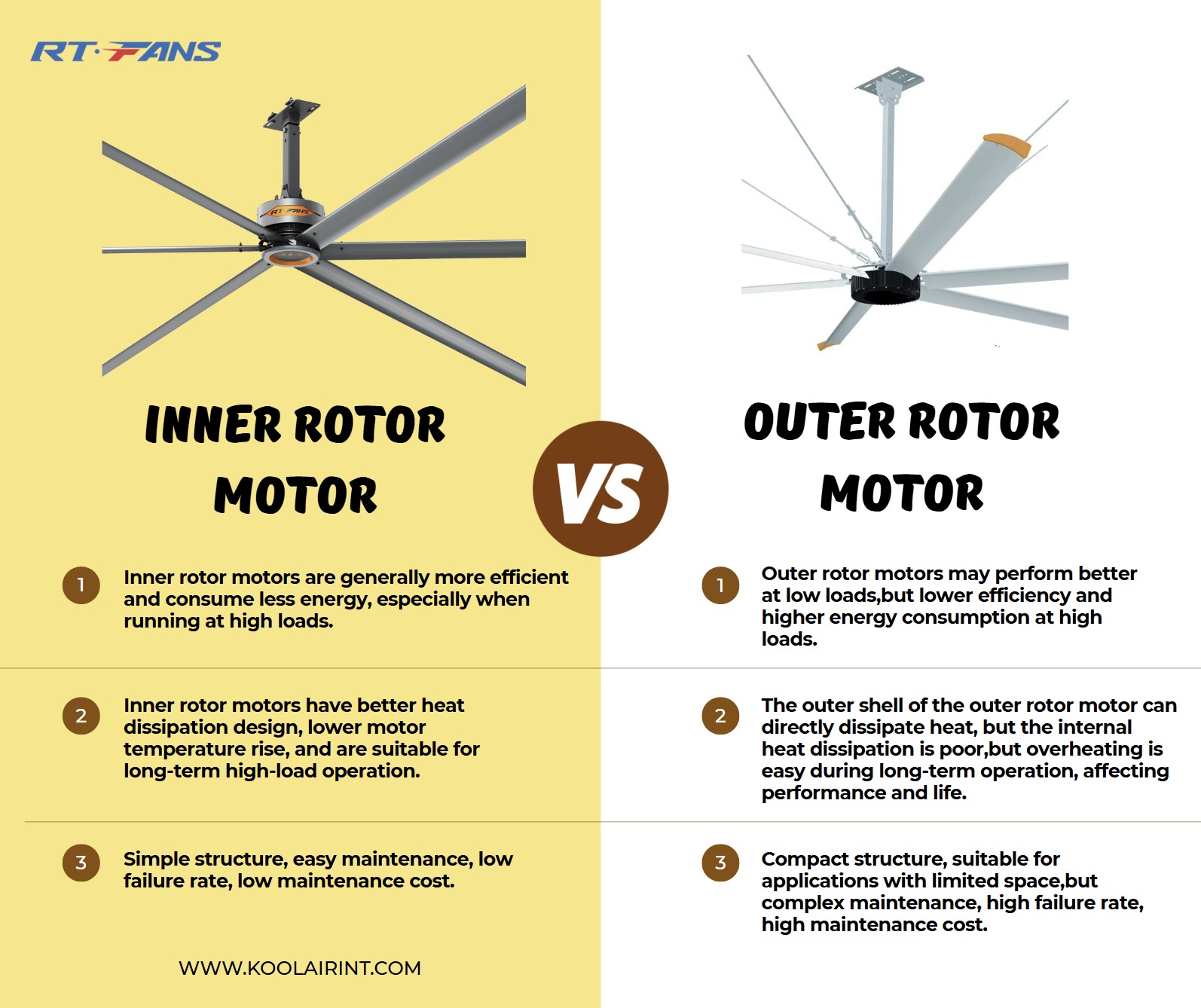
In HVLS ceiling fan applications, inner rotor motors and outer rotor motors each have their own advantages and disadvantages. The following is a detailed comparison of the two to help you better understand their differences:
________________________________________
Efficiency and energy consumption
Inner rotor motor:
- Advantages: Inner rotor motors are generally more efficient and consume less energy, especially when running at high loads.
- Disadvantages: No significant disadvantages.
Outer rotor motor:
- Advantages: Outer rotor motors may perform better at low loads.
- Disadvantages: Lower efficiency and higher energy consumption at high loads.
________________________________________
Heat dissipation performance
Inner rotor motor:
- Advantages: Inner rotor motors have better heat dissipation design, lower motor temperature rise, and are suitable for long-term high-load operation.
- Disadvantages: No significant disadvantages.
Outer rotor motor:
- Advantages: The outer shell of the outer rotor motor can directly dissipate heat, but the internal heat dissipation is poor.
- Disadvantages: Overheating is easy during long-term operation, affecting performance and life.
________________________________________
Structure and maintenance
Inner rotor motor:
- Advantages: Simple structure, easy maintenance, low failure rate, low maintenance cost.
- Disadvantages: No significant disadvantages.
Outer rotor motor:
- Advantages: Compact structure, suitable for applications with limited space.
- Disadvantages: Complex maintenance, high failure rate, high maintenance cost.
________________________________________
Noise level
Inner rotor motor:
- Advantages: Low noise during operation, providing a quieter working environment.
- Disadvantages: No significant disadvantages.
Outer rotor motor:
- Advantages: No significant advantages.
- Disadvantages: Due to structural reasons, the noise is high during operation, which may affect working comfort.
________________________________________
Adaptability and reliability
Inner rotor motor:
- Advantages: Strong adaptability to the environment, suitable for harsh working conditions such as high temperature, high humidity, dust, etc., and high reliability.
- Disadvantages: No significant disadvantages.
Outer rotor motor:
- Advantages: No significant advantages.
- Disadvantages: Performance degradation or failure is likely to occur in harsh environments, affecting production efficiency.
________________________________________
Cost and cost performance
Inner rotor motor:
- Advantages: Lower overall running cost, more economical in long-term use, and high cost performance.
- Disadvantages: No significant disadvantages.
Outer rotor motor:
- Advantages: Better initial performance.
- Disadvantages: Higher maintenance and replacement costs, and overall cost performance is not as good as that of inner rotor motors.
________________________________________
Technology maturity
Inner rotor motor:
- Advantages: Mature technology, high reliability after years of market verification.
- Disadvantages: No significant disadvantages.
Outer rotor motor:
- Advantages: Advantages in certain specific applications.
- Disadvantages: The technology is not yet fully mature, and there may be risks in long-term use.
________________________________________