
Why Choose Between a Fan and a Cooler? The Best Answer Might Be Both.
If you’ve been researching industrial cooling, you’ve probably seen the debate: evaporative air cooler vs. industrial fan. Which one is better? [...]
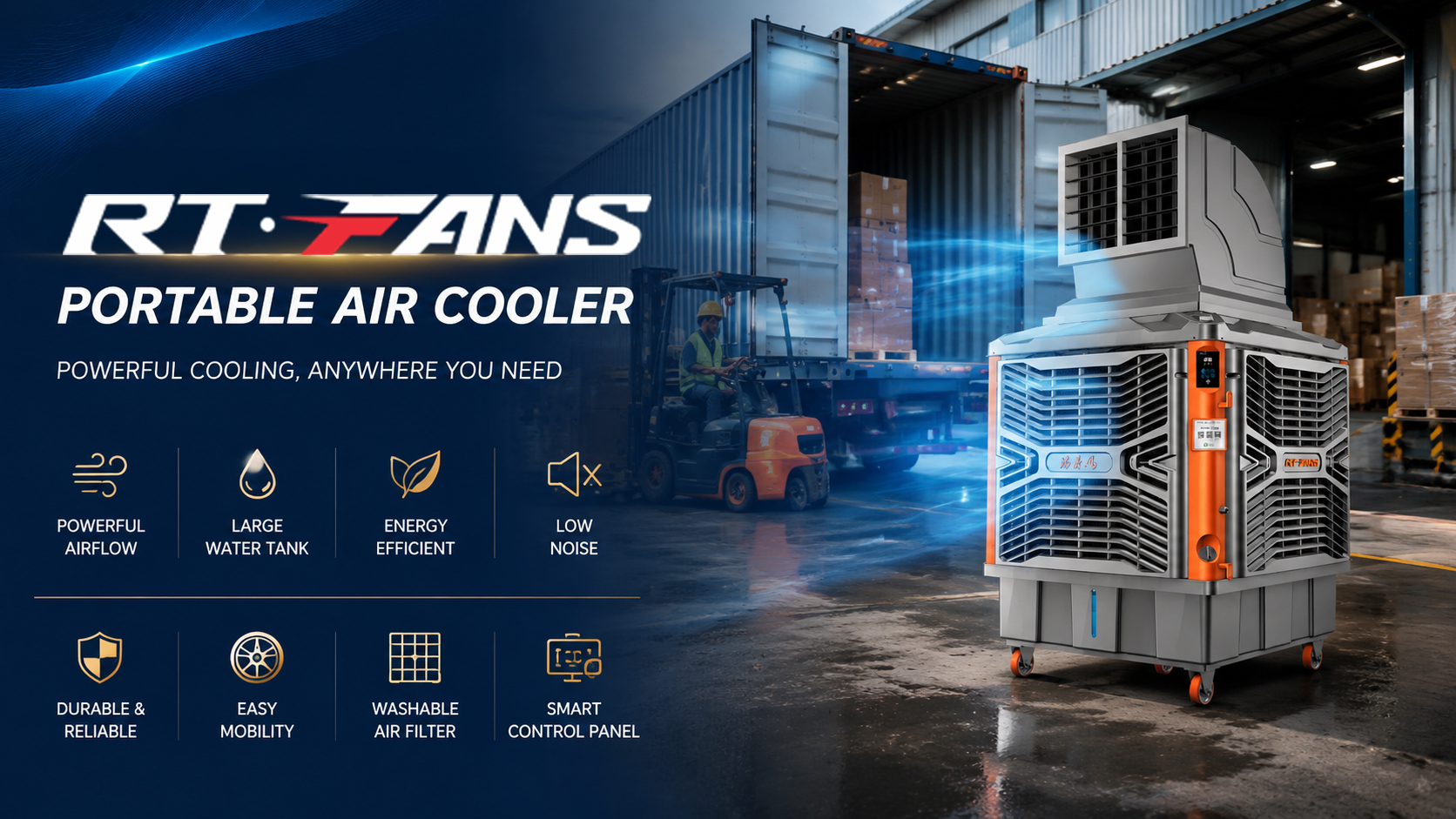
If you’ve been researching industrial cooling, you’ve probably seen the debate: evaporative air cooler vs. industrial fan. Which one is better? Which one should you buy?
One of evaporative air cooler supplier recently published a blog post arguing that swamp coolers are “better than fans” for most businesses. They made a valid point — evaporative coolers actively lower air temperature, while fans simply move air around.
But here’s the thing: you don’t have to choose.
At RTFANS, we manufacture both high-performance evaporative air coolers and industrial HVLS fans. And after over 20 years in the business, we’ve learned that the most effective cooling strategy often isn’t a single product — it’s a combination.
The Limitations of a Single-Solution Mindset
| Solution | Strength | Weakness |
| Evaporative Air Cooler | Lowers ambient temperature; brings in 100% fresh air | Requires open airflow; less effective in enclosed spaces |
| Industrial ceiling Fan (HVLS) | Circulates massive air volume; creates wind-chill effect; destratifies air in winter | Does not reduce actual temperature |
So if you put an evaporative cooler in a sealed warehouse with no exhaust, humidity builds up and cooling suffers. If you only install HVLS fans in a 40°C factory, workers still feel hot — because moving 40°C air is still moving hot air.
But combine them? Now you have a hybrid system that actively cools and evenly distributes that cool air across every corner of your facility.
Hybrid Cooling: When 1 + 1 = 3
Here’s how a fan + cooler combo works in practice:
➡ Evaporative air coolers pull in hot outside air, pass it through saturated cooling media, and drop the temperature by 5–15°C (sometimes more in dry climates). They discharge cool, fresh, humidified air.
➡ HVLS fans take that cool air and push it horizontally across your entire floor — eliminating dead zones, creating consistent airflow, and multiplying the felt cooling effect through increased evaporation on skin.
The result?
✅ Lower ambient temperature (from the cooler)
✅ Even distribution and wind‑chill effect (from the fan)
✅ Better ventilation and air quality
✅ Energy costs that are still a fraction of traditional AC
Real-World Application: When “Either/Or” Is Not Enough
Consider these scenarios:
Large warehouse with high ceilings
- Fan alone: just recirculates hot air.
- Cooler alone: cool air stays near the discharge point.
- Combo: Coolers placed along one wall, HVLS fans mounted at high ceiling — the fans pull the cool air upward and push it across the entire space. Every aisle, every rack, every worker feels the difference.
Factory with high heat load (ovens, machinery)
- Fan alone: moves hot air around.
- Cooler alone: struggles against concentrated heat sources.
- Combo: Coolers lower the overall ambient temperature; fans provide spot cooling for workstations and prevent heat stratification at the ceiling.
Mixed-use facility (warehouse + office)
- Fan alone: noisy, minimal cooling.
- Cooler alone: may over‑humidify the office area.
- Combo: Direct evaporative cooling for the warehouse; HVLS fans on low speed for the office to destratify warm air in winter and create gentle breeze in summer.
Why RTFANS Offers Both — And the Know‑How to Combine Them
We don’t just sell boxes. We design total air management solutions tailored to your:
- Facility size (cubic volume, ceiling height)
- Local climate (dry, moderate, or humid)
- Heat load (machinery, people, solar gain)
- Airflow requirements (CFM, air changes per hour)
Our product range includes:
- Energy‑efficient evaporative air coolers (portable and ducted) with airflow up to 60,000 CMH
- HVLS fans (2m to 7.3m diameter) covering up to 20,000 sq.ft. with as little as 1.5kW
- Hybrid control systems that integrate both for optimal performance
Don’t Settle for a Single Note — Play the Full Symphony
The question isn’t “Are swamp coolers better than fans?” The question is: What combination of technologies will solve my specific cooling challenge?
Sometimes a single evaporative cooler is enough. Sometimes a row of HVLS fans does the job. But often — especially in large, hot, demanding industrial environments — the smartest answer is both.
Let’s move beyond either/or. Let’s build a solution that works together.
📧 Ready to talk hybrid cooling? Contact us: info@koolairint.com